Showing posts with label Character Types. Show all posts

Friday, February 18, 2011

Don’t Be A Watson

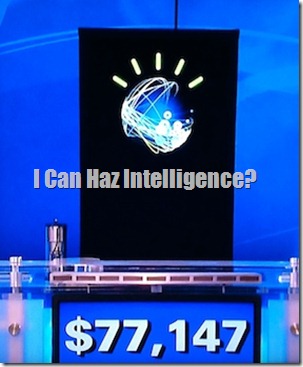
watsonI’m going to talk about how the example of IBM’s Watson is a good object lesson on what not to do in your writing. Bear with me for a minute.

I was very impressed at how IBM’s creation Watson fared at Jeopardy. As a former computer scientist at places such as Google and Microsoft, I was actually more fascinated by Watson’s failures than its successes. Frankly, I was surprised that Watson didn’t answer every question correctly and faster than the humans. Watson missed obvious questions. To me, it seemed that the machine was great at trivia, the “fill in the blank” kind of questions. Things that any Google search can answer. But it failed at more complex problems, questions that involved things like metaphor and analogy, standard fare on SAT tests. It all led me to one conclusion:

We are still nowhere near achieving “artificial intelligence.”

Watson is just a machine, without emotion, drive, or ambition. I thought of a few questions I could easily ask it that it could never solve. “Who is standing to your left?” “How’s the lighting in here?” “Who does Ken Jennings remind you of?” “Fire! Please proceed to the nearest exit in an orderly manner.”

Yes, computer scientists have created something I call “programmed intelligence.” Intelligence in very specific domains, but as soon as you step outside the domain, the intelligence fails. Because “intelligence” isn’t just about recollection, computation, or pattern analysis. It’s much more about metaphor, symbolism, and relationships.

Think about a book for a moment. A book is really just a machine. It’s a Kindle with only one book available. The words are just dots of ink on the page that create letters. The letters form words, the words form sentences, paragraphs, and chapters. Computers can be made to understand how to display and edit those letters and words, even spot incorrect ones. But a computer can never read a book and understand what’s in it. It can look up every word and phrase, but never truly comprehend the meaning, the story. And even a book can never judge your emotion reaction to the story and respond accordingly. There’s as much intelligence in Watson as in any book on your bookshelf.

There were other subtle things that Watson failed to do on Jeopardy. He couldn’t learn from his mistakes (yes, computers can be programmed to learn, but that’s the equivalent of fixing a typo). It seemed that the other contestants learned and began to challenge the machine on the third day. More importantly, Watson has no idea why he made mistakes to begin with. Watson has no insight, no self-awareness. Imagine if Alex Trebeck had said “incorrect” to Watson on even correct, obvious answers:

“Answer is: The color of the White House. Watson.”
“What is white?”
“Incorrect. Ken?”
“What is white?”
“Correct.”

Watson would just hum along, completely oblivious. If Trebeck pulled that on Ken Jennings, he would storm off the stage or go after Trebeck’s throat.

So until we create a computer with emotion and true reasoning, we’ll never have intelligence, only super-fast trivia answerers.

So you’re wondering, “what does this have to do with my writing?”

The questions you should be asking yourself is, “How are my characters like Watson?” Do your characters react to their environment? Do they have their own agendas? Are they there just to provide other characters with information? Or are they living, reasoning creatures?

Another way to look at it is to ask, “What was at stake for Watson?” Yes, hundreds of computer scientists spent years on this project, but did Watson care? If there was indeed a fire alarm during taping, would Watson react? Do you think Watson really cared about how much money it earned? But every single character in your work cares about every interaction. There are stakes involved. They want something, and your other characters are either assistants or obstacles to those goals. Otherwise they are no better than the old books on your shelves.

So when you write your stories, keep one thing in mind: Don’t be a Watson.

NOTE: The writing content of this blog is moving soon! Check out the preview at The WriteRunner.

Monday, December 13, 2010

Revision: Sharpening Characters

Revision: Sharpening Characters

sharpen charOn my never-ending quest to revise Steam Palace, I’ve come across a particular set of feedback across most reviewers:

  1. I don’t care (enough) about your character(s)
  2. I don’t understand your character(s)

So lately I’ve been researching the issue. It seems like it comes down to two separate problems:

  1. Overall, I’m not showing my characters’ goals and motivations clearly, and/or readers don’t relate.
  2. In specific scenes, not providing insight into my characters’ mindset.

So how do I address these issues? The first thing is to make my character’s motivations and goals not only clearer, but much stronger. As I write, I always have a sense of what each character is after. A lot of us want to start with “ordinary” characters who are facing somewhat “ordinary” problems. The problem come when we send these characters on an adventure. Why? What stops them from just going back home? Why do they continue to press through even when things get tough or even impossible? Why don’t they fold like a house of cards?

The fact is that they are anything but ordinary. Characters are driven. They are the people we see in real life and say, “man, I wish I could be that guy.” “Isn’t she awesome?” Or, alternately, “I wish someone would run over that dude.” Characters are Heroes, they are larger-than-life. They are extraordinary people in extraordinary circumstances.

So how does this apply to character revision? Should I give my character laser eyes and shoot him into space? No. But there are a couple things to consider.

  1. What are the Stakes? Are they big enough? What happens if your character loses?
  2. Can you increase the stakes? Make them more personal? What would your character die for? Is this the most important thing the character has ever wanted ever?
  3. Are your characters’ goals well-defined? Do they know what they want? Do you? Is what they want worth dying over?
  4. Can the reader relate to the character’s needs? Are they good, solid goals?
  5. Does the character have a life outside of the story that the reader can relate to?
  6. Do other characters care about your character? Does your character care about the other characters? Let’s feel the love.

Note that this applies both to Heroes and Villains, except for #6 where you should replace ‘care about’ with ‘hate’.

Now this doesn’t address of connecting with characters on a page-by-page basis. Here are some things I’m going to work through:

  1. Keep the characters’ goals and opposition up-front on every page. Think of a kid trying to get to a bowl of candy. They have eyes for nothing else. You character wants something in every situation, and struggles to achieve that goal. It’s either the candy or a diaper-wetting tantrum (or however your character handles setbacks). And remember, the goal is never, “learn the backstory.”
  2. Filter the scene through the POV character. If there’s nothing evocative about something in the scene, don’t mention it. React. Emote. Why does ever single word on each page matter?
  3. Dialogue is better than monologue. Especially if two or more characters are speaking at cross-purposes. Express inner dialogue when you can, but don’t overdo it.

How do you get your readers to connect with your characters?

PS. On the image above, let me suggest an edit. The balloon should read, “A conflicted Disney Princess on every page.” Then they won’t just teach reading comprehension, but maybe writing skills as well.

Friday, December 10, 2010

The Father Figure

The Father Figure

father figureI’ve noticed a thematic element in most of the fiction I write—the absence of a “Father Figure.” Now this doesn’t reflect my life…my mom and dad stayed together and he lived to a ripe old age of 75. So why write stories with a missing father figure? In fact, even in my stories where there is a father, there is no mother. So I’m left with 2 cases: single-parent or orphaned characters. Is there something of literary value in writing characters with fractured families?

I think maybe there’s an inherent conflict. There’s a sense of loss, of deep pain, of something missing in their lives. These characters are incomplete. There’s a need to reconnect, to rebuild their broken families by bringing new people into their lives. Another thing is that without exception, every single one of these characters is single (only two are even dating someone at the start of the story) and have no children (that they know about).

So this brings up a couple issues. Is this good literary fodder to explore or am I just stuck in a rut? Is there something about the Father Figure that I struggle with or avoid? Is this a character type I should explore more? Just for fun I dumped out most of my Main Characters with their parent and home status. While I’m at it I dumped out the number of siblings. Not many bros in there…I can relate to that (2 sisters). Hmm…also just noticed that when they have siblings, the Main Character is the youngest. I was a middle child. (Technically Viola is a few minutes younger than Sophia but that doesn’t count).

So that leaves me a few interesting possibilities to explore in future works:

  • Main Characters who are married and/or parents
  • Main Characters with younger siblings
  • Main Characters with both parents alive and well

Main Characters without fathers

Dawn Anami, Dawn’s Rise
Father died one week after her birth, identity hidden from her.
No father figure growing up
Mother died ~10 years ago, now an orphan living with aunt.
0 siblings

Sophia Stratton, Steam Palace
Father died 7 years ago
Mother is dying.
Lives with sister.
2 sisters, brother died in childhood before her birth

Jake, The Immortals
Father died before birth, identity unknown.
No father figure growing up
Story starts with mother’s death, now an orphan.
Potentially 1 brother he’s never met

Archie Magnuson, Dead Air
Father died  6 years ago
Mother ill, he is her live-in caretaker.
Casually dating a girl.
1 sister

Grett Hawk, Girl World
Biological parents unknown
No father figure growing up
Childhood foster mother died ~10 years ago, now has another.
Lives in a fraternal group home
15 “foster” sisters, no known blood siblings

Main Characters with Fathers

Alex Ross, 30 Days
Father still alive and kicking.
Mother not mentioned, out of picture.
Lives with girlfriend.
1 brother

Mary of Archa, Wild Mary’s Way
Father alive and kicking
Mother died ~12 years earlier
Leaves home at start of story.
0 siblings

So you can see I’ve left a trail of death and mayhem in constructing these characters. Note that tons of my supporting characters have fathers, brothers, sisters, children, etc, so this is really just about the main character.

What kind of family structures do you find yourself writing?

Monday, September 6, 2010

Novel Design: Characters

For those looking at NaNoWriMo or considering starting a novel, I’m working on a series called Novel Design.

Characters

character_jack Last week, we talked about the eight fundamental Character Archetypes in Mythic Storytelling. To be clear, “Mythic Storytelling” is an account of a Hero-type character facing challenges in order to solve some problem…which encompasses most fiction of all genres.

So here you have a concept for a character. There are tons of character worksheets online, simply Google “character worksheet” or “character profile” if you want examples. Some are in the form of long questionnaires or interviews, others are forms. I’m not going to attempt to recreate those things here. What I want to do is talk about the “process.”

Get to Know Your Character

The ultimate goal of Character Design is to know your character so well that you know how they would react to any situation. But how do you achieve that?

First, start off with some of the basic online character sheets. Name, gender, age, occupation, skills (think résumé or C.V.), family members, home, lifestyle, social status, hobbies, physical attributes. Do not carve these in stone. With the exception of gender, I have almost never kept all my original design of a character.

Next, develop a small backstory. Only include the most important events. Births, deaths, marriages, divorces. The Big Stuff. Moves, hiring and firing, greatest achievements, greatest disappointments. Remember to not go overboard. Like everything else, the backstory is subject to massive revision. You will eventually up with ten times the backstory you actually need, so it’s a balance. If the backstory really needs to be that big, maybe you’re writing the wrong story. Usually the novel itself describes the most important event of a character’s life. Note that this also varies by genre. Mysteries are all about discovering the backstory, the “crime.” Fantasies have whole extensive histories. (I’ll talk about World Building another time). For this discussion, just focus on the individual character’s history, not all of civilization’s.

The final thing you want to think about is personality and motivation. How are they with friends? Enemies? Lovers? Family? Co-workers? What are they greatest fears? Deepest desires? What do they want out of life? What will they do anything to avoid? You need to know this character better than they know themselves. Characters usually do not act in their own best interests, so define what trade-offs they make on a daily basis between what they want and what they don’t.

Use Your Character

Armed with this basic knowledge, it is helpful to put your character in motion. If you can’t wait for NaNoWriMo, then simply write a few scenes with your character and some others, maybe characters from a whole different book. Give your character a small problem to solve and see how they go about it. Work on their speech patterns, words and phrases they like, gestures they make. What sets them off? What do they fall for?

Here’s the thing. You could spend months and months working on character worksheets, detailing mannerisms and backstory and listing every article of clothing. It can be a lot of fun researching and developing these things. But worksheets are static. For me, I learn most about my characters when they act and interact with others on the page. So what I suggest is get to a level where you’re comfortable but not entirely sure. Go ahead and write your first draft. Then go through the whole process again, eliminating everything that doesn’t fit your new concept of your character, and adding things to strength them. Research where it’s weak, revise and develop where you can.

Your initial character design is what you want your character to be.
Your revised character design after the first draft is what your character needs to be.

What I’m trying to say is that Character Design is not a one-time process done over the course of a week or a month. It’s an iterative process that spans the lifetime of your drafts. Certain things don’t work. You might have made your character too passive, so when they suddenly defeat the Bad Guy it’s out of the blue. So your character needs to show some assertiveness at times. Or your character is too strong, so when they defeat the Bad Guy on page 15 you’re like, “Oops…now what?”

One last thought. I’ve planned and planned and planned, but my characters never fail to surprise me by doing something I didn’t expect or intend, but it makes so much sense or helps the story so much I can’t unwrite it. They change, they grow, they learn over the course of the novel. So when two characters kiss that you had absolutely no intention of creating a relationship between, I say go for it. Because your characters are telling you something important about themselves, something you need to pay attention to. Once they’ve kissed, once you wrote that line, you can delete the line, but the two characters will still know. And they will never be the same.

Have fun with it! And like the example above, it’s perfectly acceptable to doodle.

Friday, September 3, 2010

Novel Design: Character Types

In preparation for NaNoWriMo, I am (probably) beginning a series on “How to design a novel.” In this episode, I discuss Characters.

Novel Design: Character Types

Character_lineup Every novel needs characters. Most novels focus on the story of a single character, known as the Main Character. The Main Character is the Hero of the story (although not necessarily the only Hero).

But how does one figure out what other characters should exist in a novel? Here is a list of a few to consider, based on mythical archetypes.

  • Heroes – Self-sacrificing do-gooders. Care little for themselves, but want to fix the world. They have some driving issue that propels the book forward.
  • Villains – The Bad Guys. Always looking out for #1. Villains can be layered, one controlling another. They should reflect the specific weaknesses of the Main Character.
  • Allies – Sidekicks, lovers, friends, stalwarts, informants, mothers. These are the people the Hero can count on when the going gets rough. They watch the Hero’s back.
  • Mentors – Father/Mother figures, religious leaders, authority figures, angels, teachers. Anyone the Hero can learn from. Use the Force!
  • Heralds – The news. Directly or indirectly calls the Hero to action.
  • Tricksters – Comic relief. Can put the death of thousands into perspective.
  • Shape Shifters – Liars, thieves, assassins, prostitutes, basically anyone who cannot be trusted. They have two (or more) faces. Unpredictable and inscrutable.
  • Threshold Guardians – Thou shall not pass! Except for the $1.50 fare.

Your genre may include other archetypes. For instance, Romance requires a Romantic Interest, Mystery requires a Detective, etc.

So what does this mean for creating a novel? Start looking at the different types to see who would fill these roles.

  • Heroes – What qualities of Heroism does your Main Character illustrate? Why are they qualified to be Heroes? What must they learn during the course of the story to achieve true Heroism?
  • Villains – Who is the main opposition to your character? What do they want? Why are their interests diametrically opposed? Who are their henchmen? Which ones might be turned to the Hero’s side?
  • Allies – Who are your Main Character’s most reliable, most trusted friends? Why are they friends? What to they themselves want? Can they really be trusted? Are they who the Hero wants to be Allies or are they throw together by circumstances? Which ones bolt when things get rough?
  • Mentors – Your Hero is about to tread on dangerous ground. Who can help him through the perils ahead? Who has been-there-done-that? Does the Mentor have his own agenda? Does the Mentor steer your Hero wrong?
  • Heralds – Sometimes the Universe calls to your character. A mysterious note. A friend of a friend. An anonymous text. A call from the Chief. The buxom blond in the PI’s office. If you build it, he will come.
  • Tricksters – Do you have a character who just doesn’t care about all the grief your Main Character goes through? The Trickster is all about grounding your characters in reality, showing that things are never as serious as they seem. The Trickster is also thought of as a Child, innocent and uncorrupted, but sometimes it’s a jaded oldster giving your Hero a hard time.
  • Shape Shifters – By far my favorite archetype, and probably the hardest to define. Who wears a mask? Who is a double-agent? Who is having an affair? Think skeletons in closets, secret agendas, etc. The basic question is: Who is going to screw over your Main Character when they least expect it and are most vulnerable? Alternately, who is going to come to Hero’s aide when the Hero least expects it, especially from this person?
  • Threshold Guardians – Your characters must pass tests to advance in their quest. Who do you suppose administers these tests? Everything your Hero achieves comes at a price. Some Guardians are easy to pass, others nearly impossible.

I hope this gives you a good starting point when thinking about the various types of characters that populate novels. Note that one character can fulfill multiple roles, and that not all roles are well-represented. So you can have a Villain-Mentor, a Shape Shifting-Ally, or a Trickster-Herald. Every character can display different archetypes at different points of the story. Allies can be turned into Villains. A Threshold Guardian can become a Mentor once the test is passed.

Have fun with it. Will post soon with tips on developing individual characters.

Monday, May 17, 2010

Character Archetypes Part I – The Hero

Well I’ve been dragging my feet on starting a new writing series, but here it is. This series will explore the 8 main character archetypes in western fiction, and probably some other character types as well. Note that there are literally thousands of types of characters, but they all share some component of these basic types. No literary character is of only one type; they share many features of all 8 archetypes given the situation, but think of this as the dominant feature set of a given character. A Hero will be Heroic, a Villain will be Villainous, etc, but once in a while, a Hero can also be villainous. It’s not intended to be a box, but a guideline.

Part I –The Hero

drag_warrior This is perhaps the best understood of all the archetypes. Almost every story has a Hero. Generally stories are written around the activities of a single character known as the Protagonist, and almost by definition, that character is the Hero. This is the character the reader roots for, the character that saves the day. I could list the qualities of a hero all day, but here are a few distinguishing characters of a hero:

  • Drive/Motivation – Well any character can be driven, but almost all Heroes have the drive and motivation to alter their circumstances, and this drive pushes them towards success. This drive can be all-consuming, and propels them forward when others fall.
  • Self Sacrifice/Community – Heroes want to improve their world, and are willing to sacrifice everything, up to and including their lives, to help others. If your Hero does not risk death to achieve their goals, then you are leaving something on the table. But this self sacrifice must be for the greater good, and not a pitiful escape from reality.
  • Courage – Heroes are not fearless. But they must face their fears…in fact…they must face their worst fears in order to succeed. This fear could be their biggest motivating factor…but it eventually takes a dose of faith and courage to overcome their biggest obstacles.
  • Mutability/Transformation/Redemption – This is a fancy way of saying that Heroes must be willing to learn and change, and in fact, this may be the one feature that distinguishes them from the Villain—that they can learn from their mistakes and make good next time. In addition, they must change to achieve their goals, otherwise they would have achieved their goals in Chapter One. This is how they achieve redemption, where their crimes or misdeeds are forgiven or excused.
  • Resonance/Empathy – This isn’t as much about the Hero as about the reader. A Hero must face problems that resonate with the reader. A Hero solving a difficult crossword puzzle may not generate as much empathy as a Hero who was fired from his job. Not to say that crossword puzzles aren’t hard but it’s not as big a deal as losing one’s job. Even if your Hero is fighting the hordes of Mordor, it’s really just an allegory for fighting rush-hour traffic on some level, and people can relate to that.
  • Morality – Heroes have a higher sense of morality than the rest of us. After all, it’s through hero stories that we impart the sense of right and wrong to our youth. A Hero eschews dirty tactics and tricks, and won’t utilize human shields etc. He must fight the Villain using his own set of rules and keep to a higher standard. It’s what separates him from the Villain. A Hero would never poison a village just to kill one person. The Villain would.
  • Intelligence/Skill – Many Heroes have an innate intelligence and/or a skill set above and beyond most of us. We live vicariously through them, and aspire to possess even a fraction of their ability. They may use wit and cunning to defeat their enemies, but they keep collateral damage to a minimum.
  • Loyalty – Heroes are essentially people persons, and would rather die than let a friend down.

Hero Traps

  • Mary Sue – A Mary Sue is a Hero without significant flaws and with incredible powers. Imagine Superman without kryptonite. Make your Hero struggle. Give him flaws. Serious flaws. Achilles has his heel. Spiderman had allergies. Wolverine has no memory of the past and can’t fight Magneto. Luke Skywalker had little training and an inherited Dark Side. Your Hero cannot win every fight.
  • Who’s the Hero? – Don’t disguise your Hero, and then surprise! it was Joe all along. Sometimes you might write a Band of Brothers type story but the Hero is usually the one who faces the biggest crisis and must undergo the greatest transformation. Maybe during your draft, the Hero turned out to be someone else than you intended…so revise the story to focus on that character.
  • The Cavalry! – A Hero must solve his own problems. Avoid calling in the Cavalry to save the day. Or fairy godmothers. And if the Cavalry does arrive, it’s just to take the defeated Villain into custody.
  • Stupid Brave – Yes, a Hero has courage, but every Hero has fears, otherwise they become Mary Sue’s. Without fear, your character is a robot, and it also shows that he really doesn’t care about anything, since he doesn’t fear losing anything.
  • Anti-Heroes – Yes, the “bad guy” can be the Hero. You’ve stacked up so many flaws that the character is really a Villain. But if a Villain encompasses those qualities listed above, he can still come across as a Hero. It’s a fine line. However, the “protagonist” of the book need not be the Hero, but it’s usually the case.

What other qualities make a character a Hero?